Exploring Innovation in the Food System

Updated: Jan 21
What is innovation? Why is it important in food and farming? And how can investing in innovation drive regional economic growth?

In this article:
What is Innovation?
An innovation is a new or improved product, service, or process, or a combination of these, that differs significantly from a business’s previous activity. This innovation could lead to improved resource efficiency, productivity, investment or resilience. Innovation can bring faster scale-up, reduced risk, technology, and business evolution.
One way to consider innovation is as progress and development that would not occur in day-to-day business activities and operations. It relates to a specific outcome, ambition, or destination.
The official UK definition of innovation is based on the Organisation for Economic Co-operation and Development (OECD) definition, outlined in the Oslo Manual 2018.
Navigating the innovation journey
If you’re new to innovation, it can feel daunting. Our programme is designed to break down these barriers. Our grants and programmes were designed to encourage businesses that had never previously partnered with a research organisation or accessed innovation funding before.
Building collaboration and consortia
Innovation is best undertaken as a shared responsibility, by being part of a consortium or collaboration. This helps to share the risk and ensure the right expertise is involved in the project.
Strong partnerships typically include:
Practitioners who understand real-world application
Scientists who bring technical knowledge
Facilitators and project managers who keep projects on track
Everyone needs clarity on their role, and all partners should contribute to developing a robust project plan.

From idea to implementation
Understanding where your idea sits on the innovation journey is essential. This helps you identify risks early and plan accordingly.
Understanding Technology Readiness Levels (TRLs)
Technology Readiness Levels measure how mature a technology is. It uses a scale from TRL 1, basic principles, to TRL 9, fully proven in operation. NASA developed this system to ensure all components reached the same readiness level before integration into spacecraft.

Levels as defined by UK Research and Innovation https://www.ukri.org/councils/stfc/guidance-for-applicants/check-if-youre-eligible-for-funding/eligibility-of-technology-readiness-levels-trl/
The critical gap: TRLs 4 to 7 represent the "valley of death" for many innovations. This is where
Collaboration becomes essential
More resources and funding are needed
Recognising regulation may slow progress as for good reasons it manages safety, quality and security
Promising ideas stall without momentum to overcome hurdles.
Progress from TRL 4 to TRL 7 requires sustained effort, resources, and the right support network.
Ideas to support TRL 4 to 7 include
Setting up workshops and sandpits to share ideas, rule out options, create focus and think about funding pathways
Facilitating new partnerships along the value chain for your idea
Planning customer for scale up – who are you going to sell your idea to
Undertaking feasibility and simulation before investing in demonstrators
Considering both business case and technology.
Connecting companies to ideas
A thriving innovation ecosystem needs ideas flowing in both directions between companies, universities, and research councils.
Universities can accelerate the transition from concept to reality through sandpits, workshops, technology exploration, and idea validation. Early-stage feasibility studies help test assumptions before significant investment.
We know approaching universities can feel daunting if you haven't worked with one before. We build partnerships between businesses and research organisations, ensuring you get matched with the right academic support.
Scaling up can bring new challenges. If you’re moving from a lab-based environment to batch production, for example, you may need additional funding. It requires confidence and an investment in time. You might need additional partners like investors, or access to science park facilities. Expert guidance from people who've navigated this journey becomes invaluable. Tailored programmes with guided support, like our Food Accelerator and Mentoring service, can play a vital role.

Fail fast, fail early: The importance of failure
Failing is an important part of innovation, but it needs to happen early. A good project identifies and mitigates against risk. A fear of failure can paralyse innovation.
Cultural attitudes towards failure differ—what's seen as a valuable learning experience in the US can carry stigma in the UK.
Failing fast means learning quickly and improving continuously. Mistakes lead to better ideas and stronger businesses. Test early, gather feedback, and adapt.
The benefits of failing quickly
Save time and money – avoid wasting resources on things that don’t work
Listen to customers – test what the market wants at an early stage
Make fast decisions – move forward even when things are not perfect
Stay creative during change – be ready to adapt to market shifts
Further Reading: Fail fast, fail early - Harvard Business School https://online.hbs.edu/blog/post/fail-fast
The challenges of innovation in a food system
Innovation helps businesses to adapt to change, drive growth, and gain a competitive advantage. However, certain factors inhibit greater levels of innovation within the food system. Overcoming them could make the sector more productive, resilient, and better able to deliver positive food outcomes for our population.
Environment
Growing conditions for fresh produce vary enormously—from field-grown vegetables to salads in high-tech controlled glasshouses. Unlike advanced manufacturing environments, which are uniform and process-driven, horticulture production is less standardised.
This creates practical challenges. Consider the difficulty of replacing human labour with robotics in an orchard compared to a modern factory. Natural variabilities like weather and climate make it harder to predict innovation outcomes at scale over time. Building trust in sustainable farming research becomes more difficult when external factors can significantly impact results.
Strategy and policy
Innovation thrives where there's long-term national policy and clear strategic direction. This gives business owners confidence about when and where to invest.
Currently, there's no coherent innovation policy for the food system. Innovation needs to be part of a strategy from idea to market, easy to establish in the case of a car or plane, more challenging, but not impossible in the case of food. The greater engagement and collaboration of different trade bodies have shown leadership and co-ordination in sectors other than food.
Business types
Our sector is diverse. It includes growers, processors and food manufacturers, wholesale, and grocery, restaurants, and catering. This makes planning for innovation at scale difficult and investment difficult to justify.
Low margins in parts of the food system also create risk-averse, innovation-shy businesses. We expect that shared co-investment and risk will have to become stronger to overcome this hurdle.
Infrastructure and supply chain capabilities
The fragmented nature of the food system, combined with no clear strategy, results in underinvestment in large-scale infrastructure and supply chain capabilities in our region. For example, there's currently no infrastructure for a bio-circular supply chain that could create new uses from secondary materials or horticultural waste.
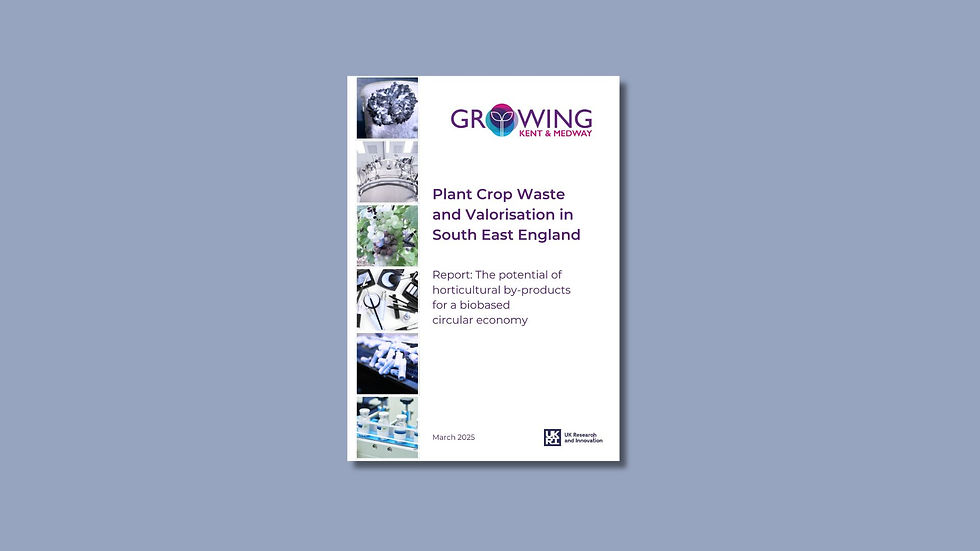
Finding Value From Plant Waste
Read our report on the potential for a bio-circular economy in the Southeast
Innovation culture
These combined factors have resulted in a sector that lacks a strong innovation culture. There's no common use of tools like Technology Readiness Levels, no shared language, and no widely used innovation metrics.
Our experience from the past five years of growing Kent and Medway gives us the opportunity to show this leadership. In addition incorporate wider aspect of our food system such as nutrition and resource use.
Collaboration with research organisations and universities is less commonplace than in other sectors. Tools routinely used elsewhere—feasibility studies, techno-economic analysis, simulation—are less familiar here. Data sharing is limited.

How we facilitate innovation
At Growing Kent & Medway, our ecosystem improves conditions for innovation in the food system. We help businesses in Kent and Medway gain the confidence, knowledge, partners, and resources they need to make innovation a priority.
We're here to support you through every stage of your innovation journey. Whether you're exploring an early-stage idea or ready to scale, we can help you navigate the challenges and seize the opportunities.
